
Use case
Driving communication adoption at
scale
Industry: Defense & manufacturing
Year: 2025
Client
A global manufacturer in the defense industry operating across air, land, naval, and security domains, where public communication carries high reputational and political risk.
Challenge
Solution
Plan-Activate-Analyze operating model implemented through Sprinklr, combined with a custom multilayered RACI change management framework focused on role simplification, phased adoption, and hands-on enablement.
Impact
Within 9 months, 48% of all communication activities managed end-to-end through Sprinklr, increased visibility and governance across markets, reduced risk, and sustainable adoption, all without compromising local autonomy.
Client Story
Our client is a global manufacturer in the defense industry: air, land, naval, and security. There, public communication directly impacts reputation, trust, and long-term business outcomes.
As the organization grew, the client was faced with increased decentralization. Operating in such a highly sensitive and regulated industry, our client urgently needed to overhaul their communication strategy and tools.
With Sprinklr as the foundation, we focused on transforming from fragmented communications into a structured, scalable operation capable of supporting the organization’s global brand and long-term objectives.
Challenge
Decentralized communication
Fragmented communication strategies due to isolated department operations. Each team runs its own show, often in a competitive manner internally.
No global oversight
The organization does not have oversight on a global level of what communication assets are planned, activated, or how they impact results.
Skewed public opinion
Lack of content monitoring, where it should have been in place, stalled the desired public opinion and brand awareness in a highly regulated industry.
Strong resistance to change
Driven by fear, legacy ways of working, and the peculiarities of working in the defense industry.
Solution: Plan – Activate – Analyze model
To address the initial challenges, we structured the transformation around a single operating model: Plan, Activate, and Analyze.
This operating model created a shared structure across markets and departments while allowing flexibility in how teams worked locally. It ensured that communication was planned with global visibility, activated through clear roles and approvals, and analyzed in the context of public opinion and strategic outcomes. Most importantly, it provided a consistent foundation upon which adoption, governance, and change management could be built.

The “Plan Activate Analyze” framework
Multilayered approach: making change possible
The successful transformation was not as straightforward. The real challenge was enabling change across a large organization where communication carried high risk and allowed for a low margin of error. To address this, we designed a change management framework that focused on reducing fear, simplifying complexity, and encouraging early-adopters.
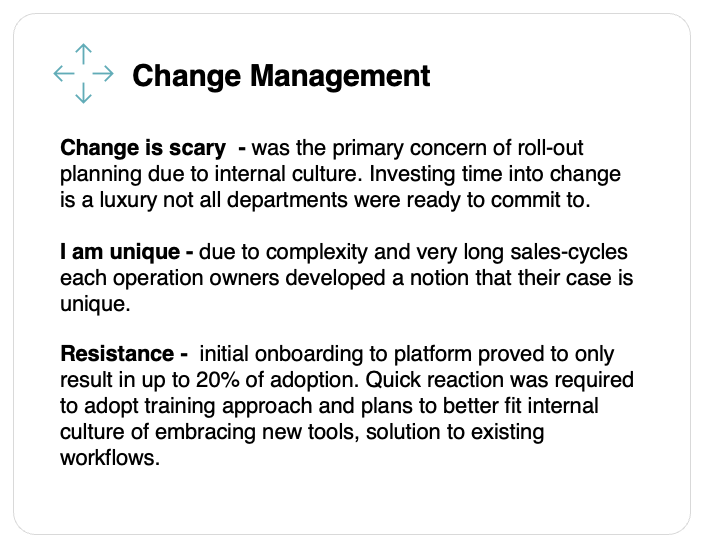
The successful transformation was not as straightforward. The real challenge was enabling change across a large organization where communication carried high risk and allowed for a low margin of error. To address this, we designed a change management framework that focused on reducing fear, simplifying complexity, and encouraging early-adopters.
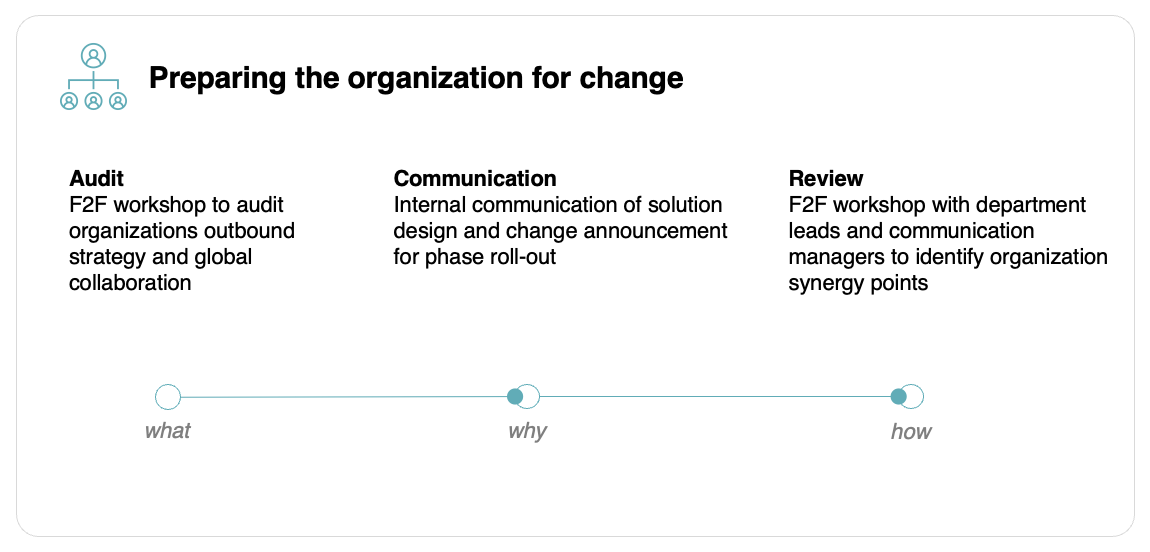
The first step was auditing the strategy and collaboration across departments and markets. Rather than assuming a one-size-fits-all approach, we conducted a F2F workshop that audited teams’ needs, wishes, and abilities. This created a shared understanding of where different parts of the organization stood and set realistic expectations for adoption.
The first step was auditing the strategy and collaboration across departments and markets. Rather than assuming a one-size-fits-all approach, we conducted a F2F workshop that audited teams’ needs, wishes, and abilities. This created a shared understanding of where different parts of the organization stood and set realistic expectations for adoption.
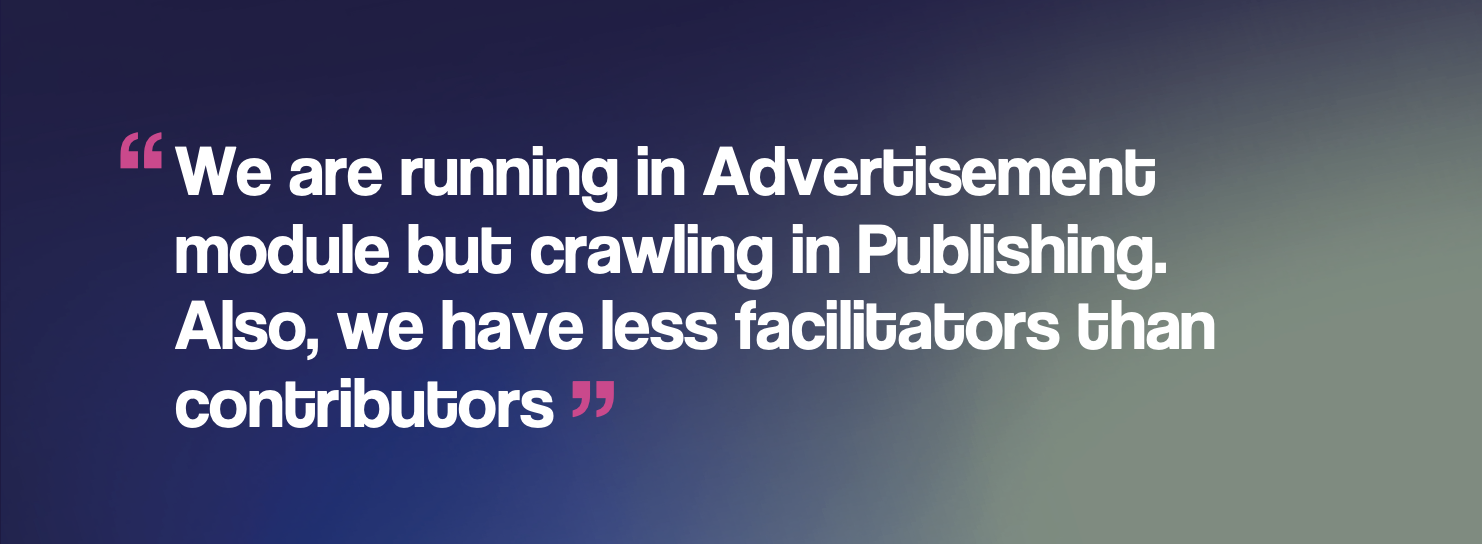
As complexity was a substantial roadblock to platform adoption, we started with simplifying the language that organization talked about change; we took the RACI model and adapted it to enterprise communication workflows. Now, when it came to structure, there were two clear roles and functions: Contributors and Facilitators. Contributors were responsible for planning, creating, and analyzing communication, while Facilitators held accountability for approvals and final publication
To support the technological side of platform adoption, we introduced a Crawl – Walk – Run model. While the employees were exposed to the platform in one go to encourage early adopters, every piece of technology was workshopped incrementally, allowing teams to build confidence step by step, aligned with their maturity level and responsibilities.
Finally, conscious of the platform complexity, user experience was tailored to role and function. Interfaces were simplified, so users only saw the tools and features relevant to their responsibilities, lowering the barrier to adoption.
All these layers enabled clear and accessible conversations on adoption progress.
As complexity was a substantial roadblock to platform adoption, we started with simplifying the language that organization talked about change; we took the RACI model and adapted it to enterprise communication workflows. Now, when it came to structure, there were two clear roles and functions: Contributors and Facilitators. Contributors were responsible for planning, creating, and analyzing communication, while Facilitators held accountability for approvals and final publication
To support the technological side of platform adoption, we introduced a Crawl – Walk – Run model. While the employees were exposed to the platform in one go to encourage early adopters, every piece of technology was workshopped incrementally, allowing teams to build confidence step by step, aligned with their maturity level and responsibilities.
Finally, conscious of the platform complexity, user experience was tailored to role and function. Interfaces were simplified, so users only saw the tools and features relevant to their responsibilities, lowering the barrier to adoption.
All these layers enabled clear and accessible conversations on adoption progress.
Our enablement
To bring this framework to life and properly onboard the organization, we led a series of structured workshops and training sessions across markets and departments.
Prior to platform rollout, we facilitated cross-department and C-level workshops to aggregate communication needs, priorities, and expectations, creating a shared foundation for the implementation.
This was followed by extensive module-specific – e.g., Social Publishing – training sessions for Contributors and Facilitators separately to support role clarity and accountability.
Adoption was further reinforced through bi-monthly, in-person sessions with communication leads, focused on progress reviews, hands-on guidance, and open Q&A.
Impact
Within nine months, approximately 48% of all communication activities were managed end-to-end through Sprinklr, marking a substantial shift from fragmented, manual processes to a structured, scalable operating model.
Through addressing the real reasons of change resistance with simplified processes, continuous and tailored live support, the organization gained increased visibility, reduced risk, and a sustainable foundation for centralized communication. All that without sacrificing local execution or autonomy.
Get in touch
Do you want to know more about Raffish and what we
can do for you? Don’t hesitate to contact us!


Get in touch
Do you want to know more about Raffish and what we
can do for you? Don’t hesitate to contact us!
Europe – Raffish works on projects all over Europe. We are not place bound and our team works both Remote and Hybrid.
Business Address: De Grote Rede 86, 5247LA Rosmalen, Netherlands